



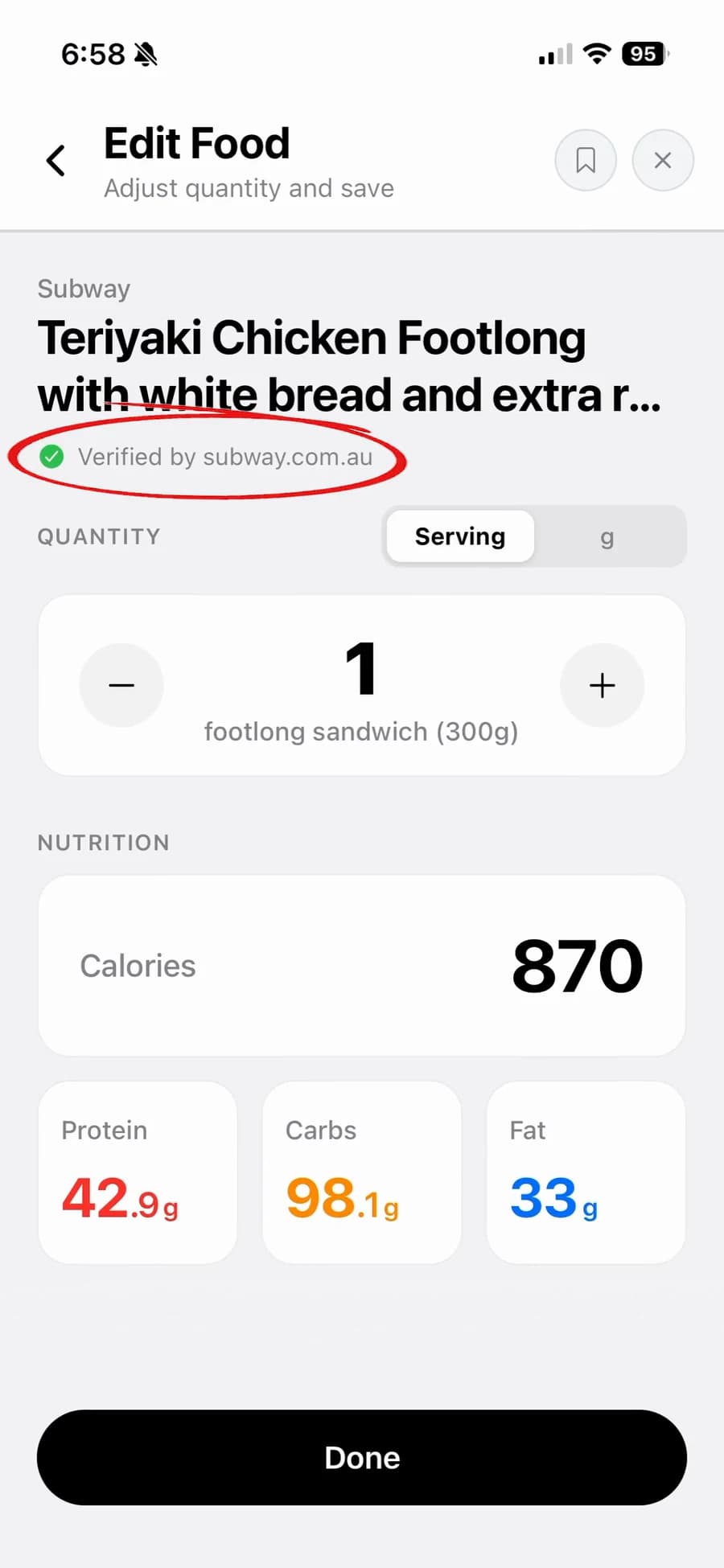
How Meal Engine verifies your food data
Whole foods — chicken breast, rice, eggs, vegetables — resolve against a curated database checked against USDA nutrition data, not against thousands of user-submitted duplicates.
Branded and restaurant foods are looked up and confirmed against the brand’s own published nutrition where it exists — that’s when you see the “Verified” badge.
Packaged foods without a database match fall back to the nutrition label itself: photograph the panel and Meal Engine reads the real values, including serving size.
When no source can confirm a food, the AI estimates it — and says so. Estimates are clearly labelled and fully editable, never dressed up as verified facts.
Why are most food databases so unreliable?
Because most trackers crowd-source their data. Search a common food in a typical calorie app and you’ll find dozens of user-submitted variants of the same item with conflicting numbers — and no way to tell which one is right. Pick the wrong one every day and your “tracked” intake can drift a long way from reality.
That’s the quiet reason so many people “track everything” and still don’t see results: the effort was real, the data wasn’t. You didn’t fail — your data did.
What does the “Verified” badge actually mean?
It means the numbers were confirmed against the source itself — the brand or restaurant’s own published nutrition for branded foods, or USDA-backed data for whole foods — rather than someone’s unchecked database entry.
When that confirmation isn’t possible, Meal Engine doesn’t pretend. The entry is labelled “Estimated by AI” so you always know the confidence behind the number.
Does data accuracy really change results?
Yes — it’s the foundation everything else stands on. Your calorie and macro targets only work if the intake measured against them is real. A plan that adjusts weekly based on your data is only as smart as that data.
Verified data in, honest adjustments out. That’s why Meal Engine treats provenance as a feature, not a footnote.
Common questions
Where does Meal Engine’s nutrition data come from?
Whole foods come from a curated database checked against USDA nutrition data. Branded and restaurant foods are verified against the brand’s own published nutrition where available, with barcode and nutrition-label scanning as backups.
What happens if a food isn’t in any database?
Meal Engine looks it up, reads its nutrition label if you photograph one, or estimates it with AI — and labels the estimate as an estimate so you can adjust it.
Can I trust the AI estimates?
They’re sensible starting points, clearly marked and fully editable. The point of the labelling is that you never mistake an estimate for verified data.
Do verified values apply to photo logging too?
Yes. Foods identified from a photo resolve through the same verified database before any AI estimation is used.